
You can also add to your health journal encourading news about advances in the epilepsy management. Here are some of them:
NeuralTree neurochip prevents epileptic seizures

Engineers from the Federal Polytechnic School of Lausanne (Mahsa Shoaran and Stéphanie Lacourt) in 2023 have developed a neurochip, NeuralTree, that can monitor and prevent epileptic seizures. The device used a high-resolution 256-channel sensor array and an energy-efficient machine learning processor. Biomarkers collected from monitoring real epilepsy patients were used to train the system. When abnormal brainwave patterns are detected, a neurostimulator located on the chip is activated, sending an electrical impulse to block the pattern. The study's authors note that the uniqueness of this neural interface lies in its energy-efficient multi-channel chip. Previous similar devices had only 32 sensor channels, which significantly limited its performance. Engineers will continue to work to achieve self-actualization of the device: the ability to adapt to changes in the patient's neural network.
Seer Home – gadget for diagnosing epilepsy at home

Diagnosing the causes of epilepsy is very difficult. Ideally, an MRI or an electroencephalogram scan would be necessary during a seizure. Some clinics even require overnight stays in diagnostic centers, where they induce seizures. This is extremely unpleasant and inconvenient, especially for children. Australian company Seer has created in 2022 the Seer Home device, which allowed to diagnose epilepsy at home. It consists of an EEG cap, battery-powered vest and recording equipment (which fits in a suitcase). The equipment includes a stand with a video camera so the doctor can determine the type of seizure from the recording. The kit is designed for week-long use. While it's not yet super-compact or convenient, it's still significantly better than spending a night in the hospital.
MEG scanner may help treat epilepsy
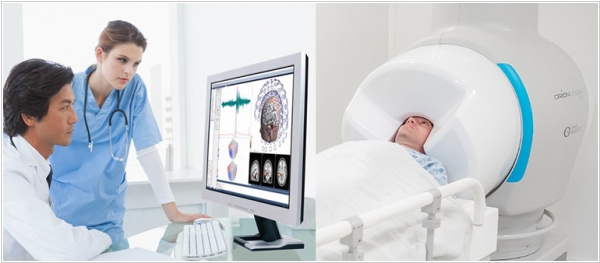
Australian company Compumedics in 2020 has received FDA clearance for its Orion LifeSpan MEG magnetoencephalography (MEG) device. Magnetoencephalography visualizes and analyzes the activation of various brain regions using magnetic fields that generate neural currents. This can help detect damaged areas of the cerebral cortex that cause epileptic activity. The device uses superconducting quantum interferometers as sensors, which can detect field strengths as small as several femtoteslas. These sensors operate at extremely low temperatures and are therefore housed in liquid helium. The cost of such a device ranges from $3 to $4 million.